Eyes / Vision
Myopia
Symptoms
People who have myopia (short-sightedness) have difficulty in seeing distant objects but can see near objects clearly. The higher the degree of myopia, the more blurred the distant object.
Formation
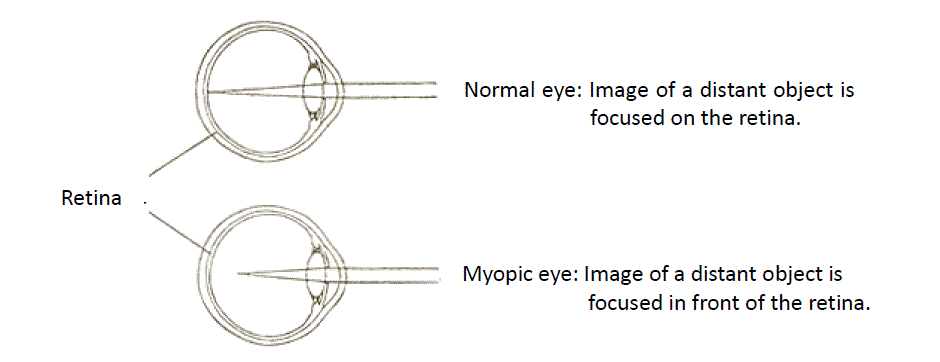
Myopia results when the length of an eyeball is too long. Light rays from the distant object entering the eye are focused in front of the retina instead of on it, resulting in blurred images.
Causes
Myopia can have many causes, two of which are genetic and environmental factors. Although how myopia develops is not clearly known yet, studies have shown that activities at close range, such as reading, writing and using electronic screen, are very important environmental factors.
Incidence
Myopia is a common eye problem in Hong Kong. About 18% of 6-year-old students have short-sightedness but the percentage increases to about 62% in 12-year-old students. Besides, the degree of myopia increases with age and it will stabilise at about the age of 20.
Prevention
Although myopia is partly inherited, proper eye care can help to keep good vision.
| 1. |
Proper habit
- Keep a distance of at least 30cm between the eyes and the books.
- Do not read while lying in bed as you may move the book closer and closer to the eyes without noticing it.
- Do not read without adequate lighting.
- Take a rest for 20 to 30 seconds after every 20 to 30 minutes of screen use.
- Change position, blink eyes and do muscle relaxation exercise frequently.
- Keep reading distance no less than 50cm from a computer screen, 40cm from a tablet or e-book, and 30cm from a smartphone.
- For students of 6 to 12 years old: limit recreational screen time to no more than two hours a day.
- For students of 12 to 18 years old: avoid prolonged screen time.
- For outdoor activity under sunlight, evening time is preferred.
|
| 2. |
Optimal lighting
- Use ceiling lights when reading. Lighting should be even and bright without excessive glare.
- For right-handers, light from a desk lamp should be shone from the left upper corner when they are writing, and from the right upper corner for left-handers. Do not shine light directly into the eyes.
- Watch television with room lights on.
|
| 3. |
Choose appropriate printed materials |
| |
- Poor quality printed materials will cause eye strain. Words should be clearly printed; both the font size and the spacing should be appropriate.
- Glossy paper can cause glare and lead to eye strain after prolonged reading.
- Dark-coloured paper reduces clarity and makes reading difficult.
|
| 4. |
Keep your eyes and body healthy
- Have a balanced diet: eat more cereal, grains, vegetables and fruits as well as a moderate amount of meat, but eat less fat.
- Eat food rich in vitamin A (e.g. tomatoes and carrots) which is good for your eyesight.
- Have adequate sleep to rest your eyes.
|
| 5. |
Have regular eye check-up and wear glasses when necessary |
| |
- Have vision test once a year. Wear glasses if myopia affects your academic performance or daily activities.
- Wearing glasses make your vision clearer but it cannot cure or prevent myopia from worsening. On the contrary, not wearing properly prescribed spectacles will affect your vision and academic performance.
|
(Revised in June 2022)
 Printable version